
How to Score 100% in CBSE Class 10: Full Strategy, Revision Tips, and Mock Test Mastery
 Nipender Singh •24 Jan 2026
Exam fear has started from January as the class 10 board exams are about to start. And students are working hard to get good percentages. Many students wonder how to score 100% in cbse class 10 board exams. From teachers to parents, everyone is paying full attention to their students and wards so that they score well in exams. And if you are reading it, you are also a student, a parent or a teacher who has a connection with class 10th.
Exams are about to start, and everyone is preparing for them. Every student wants to score well on their exams. But very few can score well and succeed in their plan. This is often because they follow a proper strategy to score well in exams. Now a major thing that needs to be understood is that every student has a different identity and has a different lifestyle altogether, so a single plan cannot work for all. Not every student is under the same course like some are in CBSE, some are in ICSE and some are in state board, etc. So, in this blog, we will discuss the major things to keep in mind for a student to score well in exams. This will be a complete guide from starting a session from april till final exams in feb or March. If you are looking only for last-minute preparation, you can also read: Last 30 Days Strategy for Class 10 Board Exams(CBSE, ICSE, State Board).
Class 10 Syllabus Overview.
Class 10 is just the first step that gives extra pressure to students to make them future-ready. That's the reason it is specifically marked as “Board Exam”. This class 10 is designed to test conceptual clarity, application skills and consistency rather than rote learning. There are so many subjects that you can opt for if we talk about different boards(ICSE, CBSE, State boards, etc.) and extracurricular subjects. We will mainly cover 5 subjects ( Mathematics, Science, Social Science, and Hindi). If you want us to cover more subjects, comment on the name of the subject below.
CBSE: Theory vs Internal Assessment.
Subject / Category | Theory (Marks) | Internal (Marks) | Total |
Mathematics | 80 | 20 | 100 |
Science | 80 | 20 | 100 |
Social Science | 80 | 20 | 100 |
English | 80 | 20 | 100 |
Hindi / Other Languages | 80 | 20 | 100 |
Skill Subjects (AI, IT, Financial Literacy, Cybersecurity) | 50 | 50 | 100 |
ICSE: Theory vs Internal Assessment.
Subject | Types of Questions | Weightage |
English | Language skills and literature skills | 80 (External) + 20 (Internal) |
History & Civics | Short and long-answer type questions | 80 (External) + 20 (Internal) |
Geography | Short and long-answer type questions, map questions | 80 (External) + 20 (Internal) |
Second Language | Language skills and literature skills | 80 (External) + 20 (Internal) |
Group 2: Optional Subjects (Choose Any Two)
Subject | Types of Questions | Weightage |
Mathematics | 2 Sections: Section A (short answer), Section B (long answer) | 80 (External) + 20 (Internal) |
Science (Physics, Chemistry, Biology) | 2 Sections: Section A (short answer), Section B (long answer) | 80 (External) + 20 (Internal) |
Commercial Studies | 2 Sections: Section A (short answer), Section B (long answer) | 80 (External) + 20 (Internal) |
Environmental Science | 2 Sections: Section A (short answer), Section B (long answer) | 80 (External) + 20 (Internal) |
Economics | 2 Sections: Section A (short answer), Section B (long answer) | 80 (External) + 20 (Internal) |
Classical Language | Questions based on translation and grammar | 80 (External) + 20 (Internal) |
Modern Foreign Language | 5 questions, all compulsory; translation and grammar-based | 80 (External) + 20 (Internal) |
Understanding the Latest CBSE Class 10 exam pattern and marketing scheme
Knowing the exam paper helps students to prepare for the paper strategically and avoid surprises. If a student understands the exam pattern properly, it helps them to plan their attempt and score well. And this is what most of the students ignore.
Most CBSE Class 10 Papers include:
Objective/MCQs
Very Short Answers Questions
Short Answer Questions
Long Answers / Case-Based Questions
Time Duration
3 Hours for most theory papers
Additional 15 minutes reading time.
For the ICSE exam, the duration for every paper is 2/2.5 hours (varying for different subjects). Students will have to write a paper of 80 marks. 20 marks are given for the internal assessment. In the ICSE English and Hindi paper have 2 hrs to attempt the paper, whereas the maths paper has 2.5 hours, with an addition of 15 mins to read the question paper in all subjects.
How You Should Attempt the Question Paper?
Initially, you just have to read the paper very carefully, as you have plenty of time to plan your paper. Once you read the paper, start the paper with those questions for which you are most confident that you know the answer. Don’t rush, take your time to answer those questions as they will give you the most marks, but in parallel keep in mind that you don’t waste time on them. Write neat, point-wise answers as they are easy to read for examiners.
Try to draw the diagrams whenever required in the last 10 mins. Prioritize answering the questions you are confident about first. Attempting questions where you have incomplete knowledge can be a waste of time and may result in low scores, especially if it prevents you from reaching questions where you could have scored full marks. Focus on maximizing your score by securing 100% on the questions you know well. Later, if you have time, then only attempt those for which you have half-knowledge or doubt in the question. Cross-check your answer sheet and make sure you did what you know. If required, you can make corrections or attempt answers that you left in a hurry. Here is a short checklist.
Start with questions you are most confident about
Don’t spend too much time on one question
Attempt MCQs carefully—read every option
Write neat, point-wise answers
Draw diagrams wherever required (especially in Science)
Keep 10 to 15 minutes at the end for revision
Phase wise preparation strategies
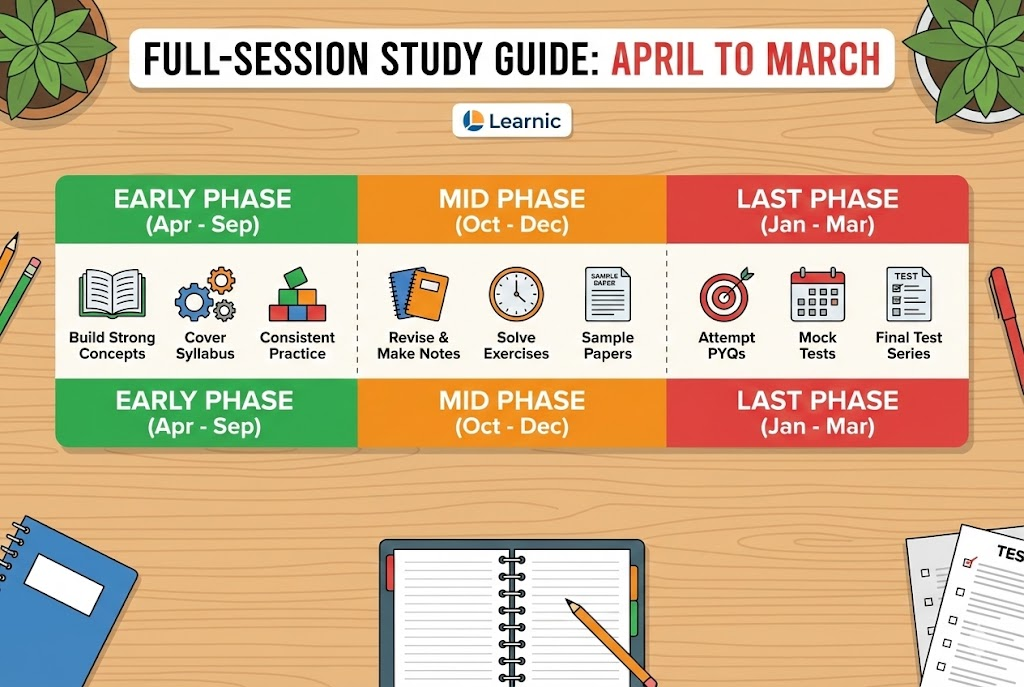
Since we are talking about the guide for full-session from april to march here is the breakdown for you.
Early Phase (April - September): Focus on building strong conceptual clarity, consistent practice, and covering the bulk of the syllabus. Dedicate sufficient time to master the foundational topics and regularly review past material. Aim for a solid understanding of core concepts before moving to advanced problem-solving techniques and rigorous test series. This phase is crucial for long-term success. If you miss the basic concept, it will be difficult for you to grab in the last months of board exams.
Mid Phase (October - December): During this time, almost all schools try to finish the syllabus and start preboarding in schools. And this is a good time to emphasize revision, making notes, and starting to solve exercises multiple times. Focus on high-weightage topics and begin practicing sample papers to simulate exam conditions.
Last Phase( Jan - Till Exams): In this phase, schools often schedule the extra classes to clear concepts and test series. Now this is the right time to attempt PYQs and mock tests. At learnic we also prepare a lot of test series for our students. Here is the link for the class 10 test series
Here is the Best revision strategy for CBSE Class 10 in last days
No new chapters
Only attempt sample papers, test series and practice sets
Formula and diagram revision
Good sleep of 7-8 hours
Divide remaining days in total chapters of all subjects and revise their notes not books. Example 20 days left and 40 chapters are there from different subjects that you are confident on. So 40/20 is equal to 2 chapters per day. Revise the notes you prepared and quick reading of the chapter. Keep 2-3 days in the buffer.
Do not study for the last 2 days.
Before your exam just revise your subject notes once again.
Core Subjects Strategies to score 100% in CBSE class 10
Mathematics
In Mathematics, consistency and practice are the only keys to success. Focus on understanding formulas and theorems first, not just memorizing them. Master the problems first, then solve the advanced questions in the sample papers and PYQs for speed. Maintain a formula notebook for easy and effective revision.

Image Source: Giphy
https://media3.giphy.com/media/v1.Y2lkPTc5MGI3NjExNW9lNzUzem02dGFpNXF3Y25nNmF5cHcxcjRlOTV2bXdxd3luZDI3MCZlcD12MV9pbnRlcm5hbF9naWZfYnlfaWQmY3Q9Zw/l2Ject9fem5QZOyTC/giphy.gif
Math improves only with practice
Understand formulas and theorems, don’t memorize blindly
Solve the course first, then move to sample papers and PYQs
Maintain a formula notebook
Science
Science is a subject that requires a balanced approach. To speed up, you must balance theory and numericals, making sure you have a strong conceptual foundation while regularly practicing numericals from Physics & Chemistry. Visual representation is key, so always draw neat and labelled diagrams whenever required, especially in Biology and Physics. For efficient preparation and retention, make it a habit to revise formulas daily.
Finally, when answering theoretical questions, particularly in Biology, focus on keywords to ensure your answers are correct and score high marks.
Balance theory and numericals
Draw neat and labelled diagrams
Revise formulas daily
Practice numericals from Physics & Chemistry
Focus on keywords in Biology answers
Social Science
To master History, create detailed timelines of historical events to visualize and recall the sequence of events easily. Regular practice of map work is essential for Geography to secure those direct marks. For Civics and Economics, shift your focus from memorization to a deep understanding of core concepts, theories, and their applications. Finally, structure your answers logically and point-wise to ensure clarity and make them easy for the examiner to evaluate, especially for long-answer questions.
Make timelines for chapters in the History section.
Practice map work on a regular basis.
Understand concepts in civics and economics instead of memorizing them.
Write well-structured, point-wise answers
Effective CBSE Class 10 Revision Techniques.
Revision is not about re-reading all the notebooks. Here, most of the students make mistakes; they just end up wasting time re-reading all the chapters of all the subjects. The revision is more than just re-reading notes; it’s all about actively engaging with the syllabus to ensure long-term retention and recall under pressure.
1. Active Recall and Spaced Repetition
Instead of passively reading your textbook, actively test yourself.
The "Cover and Recall" Method: quickly read a topic then cover your notes and try to write down everything you remember. This forces your brain to retrieve the information from your subconscious mind and strengthen the memory.
The Feynman Technique: This is quite famous in European countries which actually works. This is how it goes: Prepare a topic or a chapter and explain the concept simply to someone else like your mom or your brother. Anyone in the house doesn’t matter if he or she is able to understand or not. (or even a rubber duck!), Teach the topic out loud. This will force your brain to recall whatever you know about the topic.
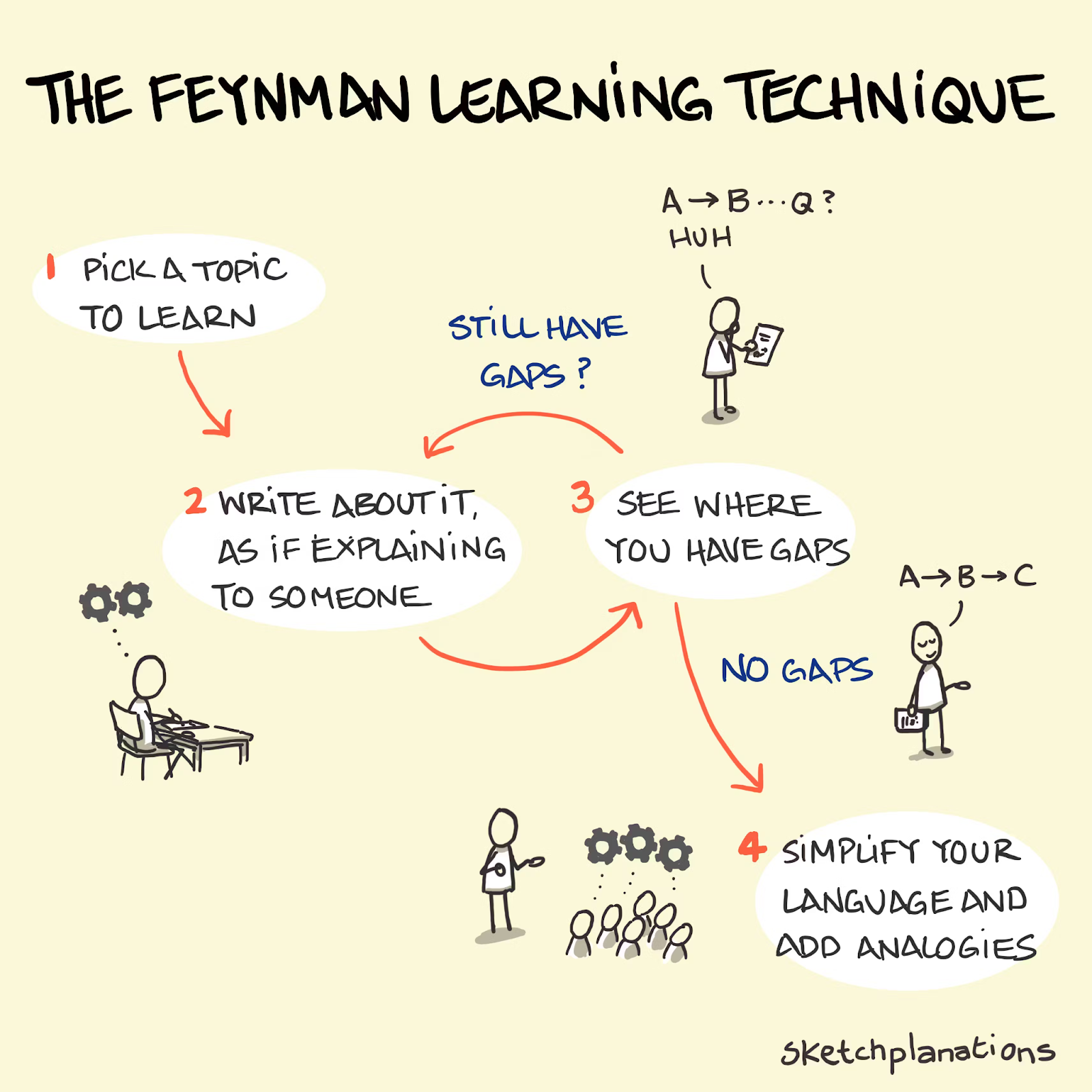
This will also help you in exams to recall that moment when you were teaching the chapter to a duck or a human 🙂
Spaced Practice: Review the study material that you prepared at increasing intervals. Read them one day or three days later, one week later. This way you will keep things in mind for a longer period of time.
2. Short Notes/Flashcards:
short Notes/Flashcards: A long answer often required to explain short dates or key points from the chapter. Create short notes or flashcards for quick revision of facts, formulas, dates, definitions, and key keywords. Keep them precise and portable.
3. Focus on Weak Areas
The 80/20 Rule: This is a well-known academic principle that suggests allocating 80% of your study time to revision and 20% to the areas of the syllabus where you consistently struggle or lack confidence. Utilize tools like color-coding or a dedicated tracker to efficiently identify these weaker chapters.
Error Log: You can maintain a notebook where you can write down every mistake made in tests, mock papers, and practice sessions. Later work on the mistakes instead of the entire concept. Note and practice the correct solution and the concept behind it. Review this log weekly and improve.
Mastering Mock Tests
Mock tests are quite important for your 10th board class as they are a dress rehearsal for the final board exam. It is like a mock drill that the army used to do before a war. Treat them with the seriousness they deserve to build stamina, manage time, and reduce exam-day anxiety. These class 10 test series for all subjects available on learnic platform too. You can attempt there and check your rank in the leaderboard(state and country wise).
1. Simulate Exam Conditions
Time Constraint: Always attempt a mock test within the given time limit (e.g., 3 hours for an 80-mark paper or 2 hours depending on your board i.e CBSE or ICSE). Do not take unnecessary breaks or extend the time. You have to follow this strictly.
Environment: Treat mock tests, PYQs, Practice sets as your main board exams. Sit at a desk, away from distractions (phone, music, etc.), just like in the examination hall.
Resources: Use only the resources allowed in the actual exam (e.g., pen, geometry box). No textbooks or notes.
2. Follow the Exam Attempt Strategy
Reading Time: Utilize the 15 minutes of reading time fully. Plan which sections to attempt first and mentally allot time to each section/question type.
Start Strong: Begin with the section or questions you are most confident about to build momentum and ensure you secure those marks.
Time Management: Stick to your planned time allocation. If a question is taking too long, move on and come back to it later if time permits.
Boards are not just for exams for students, they are for parents too!
Board exams are stressful not only for students but also for parents. Every parent wants their child to succeed, and most genuinely try to provide the best support possible. But somehow, in this process, many parents unknowingly
Compare their child with others
Set unrealistic expectations
Create extra pressure instead of motivation
And this often affects the student’s confidence and mental health. There are several things that parents can do to avoid this. If you are a parent reading this blog, you should read: How parents can help their child succeed in school.
Conclusion
Success in class 10 board exams is less about last-minute reading. It is more about adopting a structured, year-long strategy which focuses on consistency and deep understanding. By keeping in mind that a student has to prioritize concepts clarity in early months and then slowly transitioning to focussed revision and note making. And in the last months practice with test series, PYQs and practice sets to strengthen your learning.
Make sure you have to follow learning techniques like the Feynman technique and maintain the disciplined method of study time and work on your weak areas. When exams on your head practice the approach of solving questions that give you confirmation masks from known questions first.
Remember, these are just exams and they do not define your entire future. A little healthy stress can be beneficial, but worrying too much about the result will only make you feel sick and drained. Focus on the effort you put in, stay calm, and know that your worth is so much more than any score.
FAQs
How to get 100% in CBSE class 10th?
To score 100% you have to be disciplined and consistent throughout the year. There is no last 30 days strategy that will work if you haven’t attended classes and work on your knowledge from basics to advance. So there is no shortcut to get 100%. Plan your entire year, work on your knowledge and routine.
What is the typical exam pattern and time duration for most CBSE Class 10 theory papers?
In the latest exam pattern most papers include a mix of objective and MCQs, very short answer questions and long answer questions. Total time allotted is 3 hours in CBSE and 2.5 in ICSE with 15 mins of buffer time to read the question paper.
What are the key strategies for excelling in Class 10 Social Science?
There is a strategy which most Learnic teachers suggest that students should prepare a detailed timeline for history chapters with regular practice of mapwork for geography. Preparing notes for concepts of civics and economics instead of memorizing them.

Written by