
Last 30 Days Strategy for Class 10 Board Exams
 Nipender Singh •22 Jan 2026
Sometimes you feel that you don’t have time and sometimes you feel like you have plenty of time. Sometimes you feel like I have completed the syllabus and sometimes everything is left.
These kinds of thoughts will always be there in your mind till the date when you attempt the last exam. So let us begin to prepare a strategy for 10th class board exams that will help you in scoring good grades.
Image source: giphy
https://media4.giphy.com/media/v1.Y2lkPTc5MGI3NjExOWgweHRlZW80MWc0eDZjamYyNHY1b2w0aW0wa2l0ZGM2ZDR2MG1jcyZlcD12MV9pbnRlcm5hbF9naWZfYnlfaWQmY3Q9Zw/4LQJxbqT1HD53QkIGF/giphy.gif
Now it's time for your 10 class Board exams and you are here to streamline your study for the next 30 days. A major thing to keep in mind is that every student follows a different study pattern and this is also true that a single strategy will not fit every student. We will discuss a couple of popular strategies in the market opt by different toppers of different boards. You have to choose one which suits you best. But there is a simple strategy that fits most of the students and literally helps hundreds of students to score good in exams. Let us discuss that and then we will discuss a couple others at the end.
Winning Strategy: The “Traffic Light System”
So the winning strategy is not to just prepare a timetable which applies on all the chapters of a subject and the same will apply on all other subjects. This is the wrong way to plan.
Diagnostic revision of the entire syllabus of each subject will help you to score good in exams. What that means. Let me dissect for you. Day 1 starts when you start preparing a blueprint for your final exams. That can be the last 30 days remaining for your exam but not in the last 5 days. Take the printout of the syllabus.
Mark the chapter/topics in three colors.
Red: the red color means that you don’t know anything about the topic. You need to study the chapter from the very beginning and in detail. You have to prepare detailed notes on these chapters.
Orange: This color shows that you have some idea about the chapter/topic but need a revision or maybe a little more detailed study to understand it better.
Green: That is great! It means that you know the chapter/topic very well and understand almost everything. Just need a short revision and you are ready for a test😀
Now the hard part starts i.e time allocation. The time allocation to the above topics is quite critical as every student has their own pace of learning and time to understand a topic. There is no thumb rule for any topic that you have to give 80% or 70% of time to this topic. Everything is decided by the student. So you can change the time required to understand the topic.
The time allocation for Marked topics
Day 1-10 ( 60%-65% on Red): Don’t ignore the difficult chapters. They might cover 5-10 marks of your total but may impact your percentage by 6-12%. So, the preparation tip is to not read the same topic from different material 5 times rather watch a full-length video and take notes from it.
Day 11-20 (30-35% on yellow): These are the topics where you understand the basic idea but need more practice to truly master them. It's crucial not to ignore them, as they connect your weakest areas (red) with your strongest areas (green). With these topics, a fully correct answer will earn you full marks, but incomplete or partial knowledge might only earn you half marks or even zero. So prepare them well. Solve PYQs and practice sets to change the color from yellow to green 🙂
Day 21- 29 ( maintenance for green): Just spent a short time reviewing the chapters and attempting test series and practice sets. Once you are fully confident it’s your choice to revise the red and yellow chapters again to turn all of them into green.
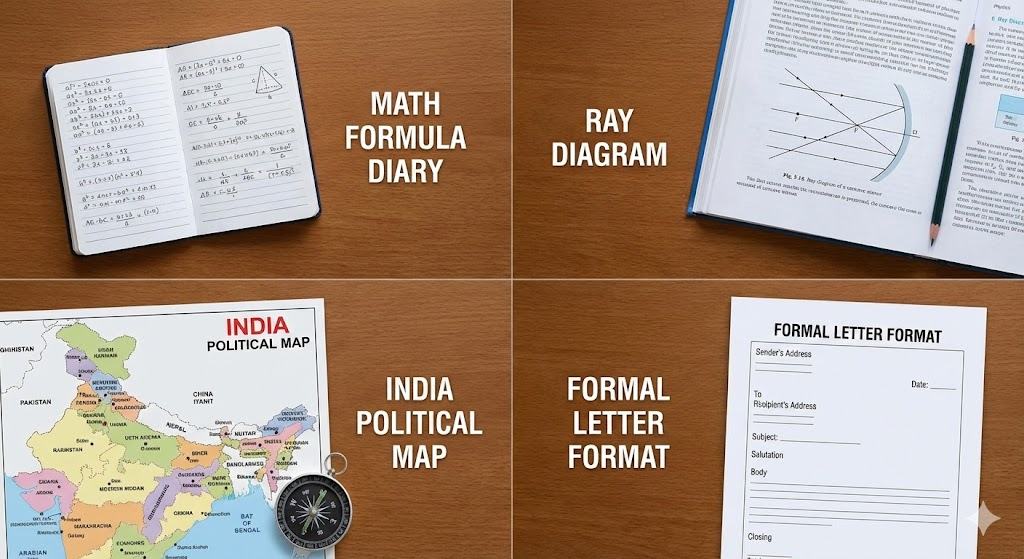
Subject | The important things to do |
Mathematics | Maintain a Formula Diary. Solve every single example in NCERT; Boards often pick those verbatim. |
Science | Focus on Diagrams and charts. For Physics, practice sign conventions in Light/Electricity until they are muscle memory. |
Social Science | Answer in bullet points. Use the last 30 days to practice Map Work daily for 10 minutes—it's free marks. |
Languages | Focus on the Format. You can't predict the story, but you can perfect the Letter, Report, and Analytical Paragraph formats. |
A key strategy often talked by our expert Prabhakar Raut is
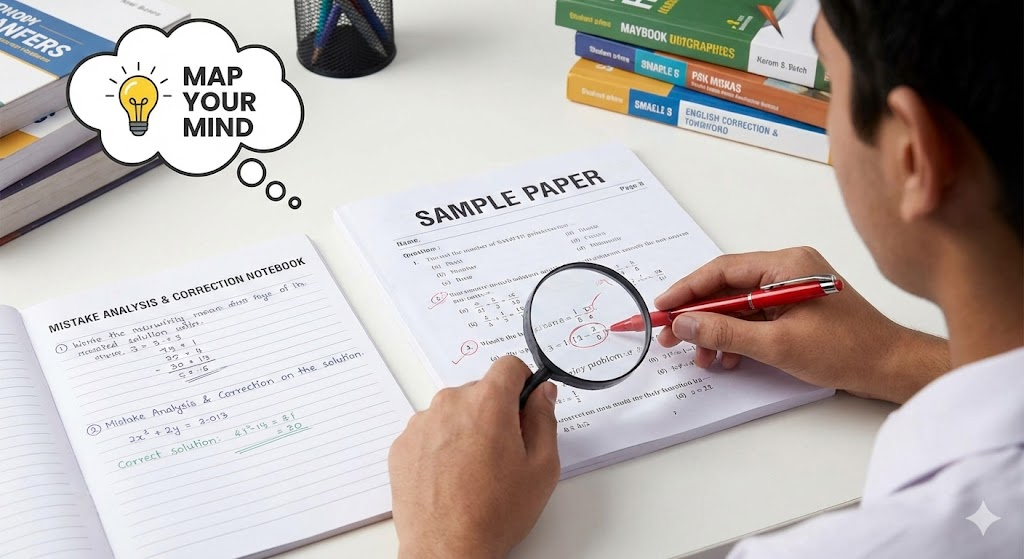
“ It is better to solve one sample paper and spend 2 hours to analyze the mistakes then solving 5 sample paper and never look at your mistakes again”
Prabhakar Raut
Why?
Because when you spend time on your attempted answers and are able to find the mistakes it is easy for you to correct them and map your mind so that you will not make mistakes again.
For example: you made a mistake in trigonometry and you know that and try to solve it again and clear the concept it will be easy to score on board then leaving it and moving on to the next test paper. Hope you got the point of discussion.
There are couple other strategies popular in the market
The Feynman Technique (For Concept Clarity): that we talked about in one of our blog How to Score 100% in CBSE Class 10 you can read more about that in that blog.
The Pomodoro Technique (For Avoiding Burnout): this talk about focus study for 25 minutes and take a short break of 5 minutes. After 3-4 such cycles take a long break.
The Blurting Method (For Active Recall): it talks about reading a topic for 10-15 minutes and then closing the book. Now write down everything you remember on the page. One of the effective techniques but for this you need at least 6 months to finish your syllabus that's why I haven't discussed it. 🙂
Simple Comparison between other techniques
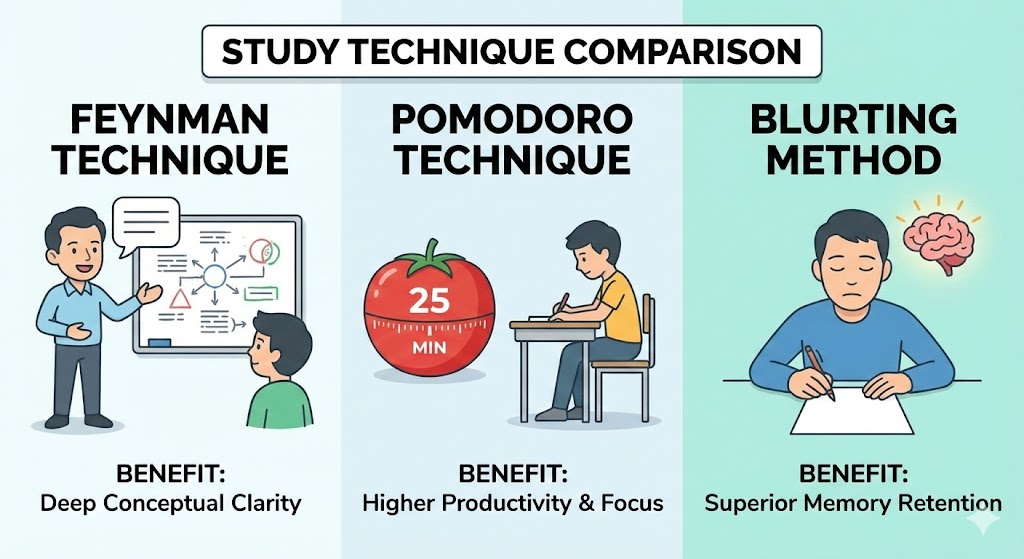
Strategy | Ideal Student Type | Biggest Benefit |
Feynman | The one who "understands" but fails in conceptual questions. | Deep conceptual clarity. |
Pomodoro | The one who gets distracted easily or procrastinates. | Higher productivity and focus. |
Blurting | The one who forgets everything during the exam. | Superior memory retention. |
Students keep in mind that this blog is not about how hard you work for your exam but how strategically you move. Whether you opt for the traffic light system to fix your weak spots or use blurting method to lock in your memory. The goal remains the same and that is transition from passive reading to active solving.
Overview
Remember the anxiety of forgetting everything is a natural part of the process even toppers feel it. The difference lies in the discipline. The only difference between topper and mediocre is that the topper follows these strategies throughout the year and uses some specific ones during the end to finalize their success.
However, it is always better late than never to chase excellence. You still have every opportunity that a topper has. The only difference now is that you must work with double the intensity and focus of those who have been preparing all year.
Finally, take a deep breath, pick your strategy, and give it your best shot. Your future self will thank you for the grit you show right now.

Written by